Affichage des articles dont le libellé est Napoleonic Era. Afficher tous les articles

dimanche 10 août 2025

Basing before packing...

 ... Then moving! Within two months, I will be away. Not very far, less than 5 km from here, but we have a lot of stuff to move, including several thousands of figures, among which at least 2000 are painted. I've not decided yet how I am going to take them away, but I'm sure that the painted figures will be safer if they are stuck together on MDF bases.

So I'm in the process of gluing the figures, starting with the Napoleonic French troops.

The Mamluks are going to engage some Mantic zombies

This is the first batch of French troops: guard cavalry, light and heavy cav, Neapolitan line, Bavarian line, and one battalion of French line.


More French and British Napoleonics to base, then Ancient and Medieval figures... Wish me luck :)

Any advice from those who have already moved large collections of figures is more than welcome!
 

samedi 19 décembre 2020

2020 Advent Calendar: Day 19

Grmmpf... If we had to invent the advent calendar nowadays, I'm sure the painters would negotiate a period with regular holidays, something like a week-end... Well, anyway, I had to work late yesterday evening (because of my job, I mean), and I will soon start another working day today, so I'm in a hurry to finish this post :)

For day 19 of the 2020 Advent Calendar, we jump through time to reach Europe at the beginning of the 19th century, and we have a look at British Riflemen in action.

In the previous post, I was inspired by a painting made by Angus McBride. For today, my inspiration finds its source in the wonderful work of a fellow painter, Bill Slavin, whose blog can be seen here.

Bill's scenes representing the war of the Peninsula are very nice: excellent paint job (full units, not only a few guys) with serious preliminary research, and also excellent modelling for the landscape.

My own guys are defending a small field, surrounded by hedges and even an old wall. We can notice some fruit trees in the background. These Riflemen belong to the 95th regiment - they are easy to recognise because of their typical green jackets. On the pictures below, we can see a few soldiers from various line or light regiments fighting as well.


All Napoleonics fans will have seen that the Riflemen come from the famous Revell set.

The red fusiliers come from Airfix, Hät and Qualitycast (metal).

I almost used my last scenery elements in this scene, with some hedges and a cultivated field. Fortunately, there's only 5 days to go, so 5 ideas still to be found :)

See you tomorrow.

samedi 5 décembre 2020

2020 Advent Calendar: Day 5

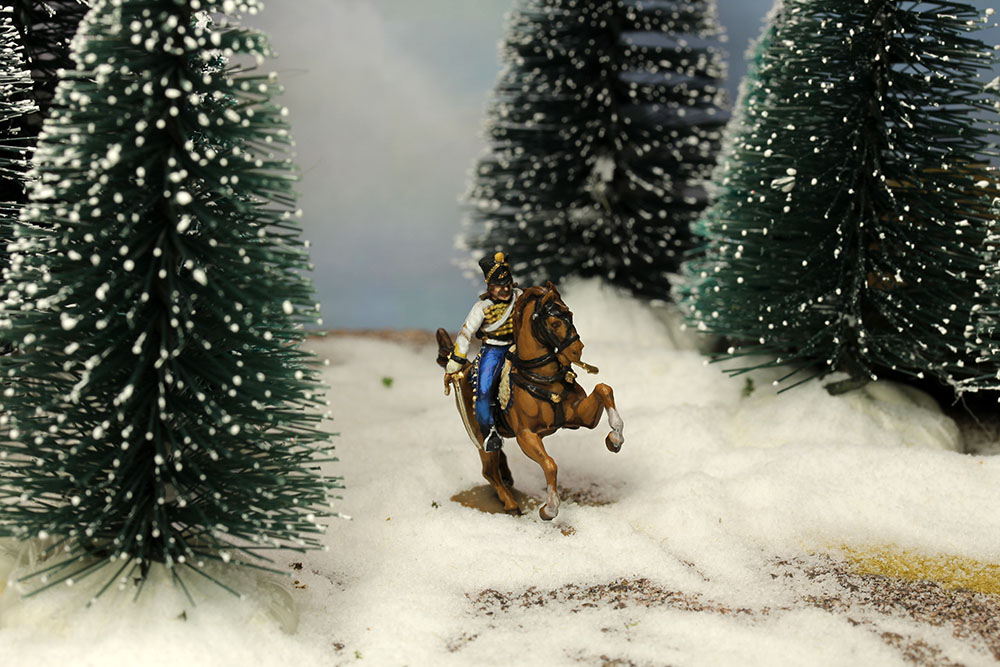
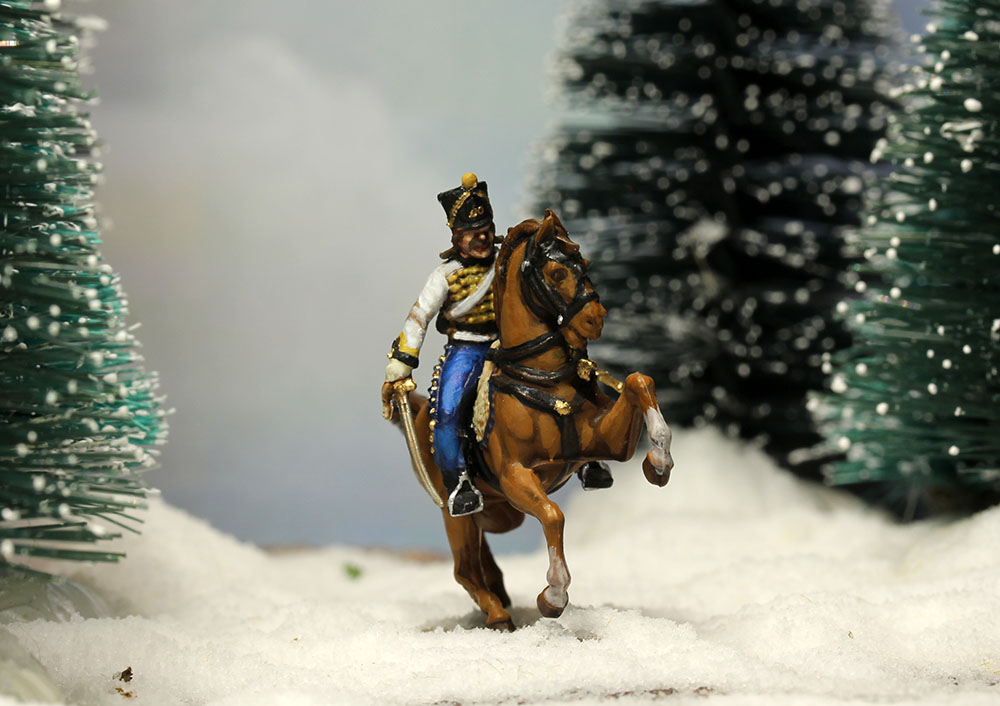
The fifth image of the Calendar represents a winter scene, again - winter is almost here after all :) Only one  figure, a french hussar during the Napoleonic wars.

This rider belongs to the 5th regiment of hussars (ex "Hussards de Lauzun"). During 1806, the 5th regiment, together with the 7th, formed a Light cavalry brigade under the command of General Lassalle. They took part of the 1806 winter campaign against the Russian Empire and were involved in the battle of Golymin (December 26, 1806).

Our man is scouting in the area of Golymin just before the battle. His sword is drawn because the place might be occupied by Cossacks. But so far, the forest is quiet and the sky rather bright.


The white uniform revealed extremely pleasant to paint. These Italeri hussars were released in 1996, but they are still among the best Napoleonic figures ever made.

This is the first post related to the Napoleonic era since January, the last one was dedicated to the fusiliers-grenadiers of the Imperial Guard.

See you soon :)


dimanche 26 janvier 2020

Fusiliers-grenadiers of the Imperial Guard

After a couple of posts related to Star Wars, back to 1/72 and the Napoleonic era. This week-end, I have painted a company of Fusiliers-grenadiers, a middle guard unit attached to the regiments of Grenadiers à pied.

Much less known than the units of the old guard, the fusiliers-grenadiers formed a regiment created in december 1806, and disbanded in may 1814. The regiment consisted of two  four-companies battalions, for a total strength of about 1800 men.


I've painted a unit of 10 soldiers, 1 NCO (first figure from the left) and 1 officer wearing a surtout.
Those who follow this blog from the beginning may have recognized the unexpected guest, the goat-that-travels-through-time. So a little game: could you find the year, and the post in which this goat was spotted for the last time ?

 Meanwhile, the plastic soldiers keep on marching through the village.


Nothing new regarding the painting technique, which has already been explained a few years ago at Benno's. I could copy a link to the post with the explanation, but I've just checked, and I realized that:

  1. The post is difficult to find since I answered a question (by Sceavus :)) in a thread regarding half orcs
  2. The pictures used to explain are no longer visible since the host on which they were stored is no longer in activity.

So I think it might be a good idea if I put everything here. Here you are:

Concerning white: when I want to paint white clothes, I first don't use white, but I start to paint a light grey layer, with a Citadel paint called Deneb Stone (in their old denominations, I don't know the name in their current range).

An example, with a Fusilier grenadier (french middle guard by Hät):


Then I wash the area with Agrax Earthshade - not much on the light grey area, or the shading might be too strong - well it is a question of taste.


Then I begin to lighten. I paint a layer of pure Deneb Stone (carefully, because at this step you have to keep your shades as thin lines between the different elements: clothes, belt...). Then I mix Deneb Stone and white, and I add a new thin (diluted) layer on some areas only - those that receive the sunlight. It is possible de repeat this operation several times on always smaller areas - it depends on your time and on the quality you want to get.

In my example, the belts are painted in a whiter color than the clothes. In the picture below, you have the three steps illustrated on three different minis:


Concerning the flesh, I use a red ink to shade the face and the hands, but I am not very happy with the result because the contrast is not strong enough in my taste. I will go back to my previous technique, a simple wash of diluted of Citadel Dark Flesh (ancient range, it is a sort of brown red), then lightening as explained before. The only difference is that I lighten the flesh paint with Citadel Ushabti Bone (something like ivory), NOT white.

Here you are the result:


I hope you find this little explanation useful, and that you like the result :)

vendredi 3 janvier 2020

Mamelouks de la garde impériale

Happy New Year everybody!

After a break (almost one week, we had a great time with our families, both in Orléans and Aix-en -Provence), I'm back to the brushes, once again with Napoleonic horsemen, and among the most impressive: the Mamelouks de la Garde Impériale.

Bonaparte recruited some Mamelukes during the campaign of Egypt. Several dozens eventually followed the French army back to France, where they formed a squadron attached to the Chasseurs à cheval de la garde.


According to the ruleset I might use for wargaming, I only need 2 or 3 riders to complete the squadron. So this unit is virtually complete :)

Hope you like them :)

Oh, by the way, this blog is now 3 years old since the end of december.

dimanche 22 décembre 2019

Second grenadier à cheval de la garde

Good evening (it's winter, seems that the evening replaced the day any time), I hope that most of you will enjoy some vacation for Christmas sooner or later. There's only a few days left before the end of the year, so it's high time to finish what can be.
In my plans for this year, I wanted to paint a few grenadiers à cheval, so that my French Imperial Guard project (long term project, Fantasy and Ancients come first) record some evolution this year.

Well, the result is very modest since I painted only one horseman (and his horse too). Together with the one painted, hmm, last year, they form a very small unit, maybe a squadron (some rulesets require only two cavalrymen).

Very little pictures for this very little step :)


I have 3 more undercoated, but it's very unlikely that I finish them before the end of 2019.
Hope you like them anyway :)

lundi 11 novembre 2019

Portuguese soldiers of the Peninsular war

Probably because winter is coming, I need to paint some figures that remind me of the sun of south Europe. The Spanish guerilla leader was a first step into the Peninsula war, so I searched in my old boxes for other figures related to that conflict. I could find old Qualitycast metal figures I bought together with my Spanish guerillero: other guerilleros (I have only 4, not a lot), enough British line to represent a battalion, and a few Portuguese soldiers, 8 line and a dozen Caçadores. The line soldiers had the stovepipe shako, so they were ok after 1811, and the Caçadores had the Barretina cap, so early soldiers. I wanted to paint late Caçadores, so I converted some British soldiers of the 95th just by removing the cords of the shako.

Here you are the result:


Three of them are plastic soldiers from the Revell 95th regiment set, whereas the 2nd trooper from the left is a metal figure by Kennington. These troopers belong to the 6th regiment of Caçadores. Not sure of the color of the plume, I have to keep on researching.

The same figures with two pre-1811 Caçadores by Qualitycast:


Close-up shot of the Qualitycast figures: troopers of the 5th regiment (Campomayor).


The three first line soldiers were also painted this week-end (Qualitycast figures). They belong to the 7th regiment (Setubal).


And a general view of the troops so far:

What do you think of my (very) little conversion, is it accurate ? And if you have the answer for the plume color, I would be glad to read it :)


vendredi 8 novembre 2019

José de Espin

In the previous post, I asked you to identify the last mini I had painted. Fire at Will answered very swiftly: the mini represents a Spanish Guerilla leader by Qualitycast - a metal mini.

But who is this man ? His name is José de Espin, one of the leaders in the guerilla band of Don Juan Martin. He's been portrayed by Denis Dighton (a contemporary English painter) in 1813 in the picture below:


This image is the source for the plate below, taken from Uniforms of the Peninsular Wars 1807-14 by Michael Chappell.


 Strangely, the blue jacket of the original picture was changed to green in this book, hence the color chosen for my mini - I didn't look for the original picture before painting, I should. So remember: primary sources first !!


Maudlin had proposed Juan Martin Diez, an important Spanish leader nicknamed El Empecinado (meaning the Undaunted). Looking at his portrait and historical background, it was not far from the right answer !


dimanche 3 novembre 2019

Will you guess...

After more than a month dedicated to Orcs, I really need a break, and to paint something completely different.As written in the comments of the previous post, I have a lot of plans - at least a lot of wishes, both for Fantasy and historical armies.

Fantasy:
- an Empire army to fight against the Orcs (using historical minis, so I would paint both fantasy and historical at the same time)
- a Fantasy Egyptian army, with a mix of historical and fantasy figures, the famous mummies
- an Undead army - infantry finished, but the cavalry not started
- an Uruk-Hai army to finish

 Historical periods:
- Mayas
- Aztecs (they are painted for 25 years, I'd like to add some contrast)
- Early Imperial Romans (same as above)
- Greek hoplites (same as above)
- Ancient Egyptians (40% done, but the chariots...)
- Sea People (50% done, less chariots :))
- Sassanid Persians (not even started)
- a Crusader army to finish (almost done, only 2 knights and one monk left to paint)
- an Ayyubid army to finish (only 30% done)
- HYW English (50% done, so many archers...)
- HYW French (10% done, not a single knight on horse)
- Feodal Japanese (5 minis painted)
- Napoleonic French army (peninsula)
- Allied army for Peninsula

 As I was looking for a musician to paint (yes, the musician of the month, remember ?), I found a mini that I had completely forgotten. I remembered that there was an illustration in a book with a good color scheme for this mini, so I gave up all my plans and started to paint him immediately.

You wander what mini it is, right ? I will show you, but I won't tell you, and I offer a challenge instead. Let's have a look:


So now, can you tell me:
- who this guy is ?
- who the manufacturer is ?

I hope you will find, I think it's not that easy, even some sort of cheat.
The answer in the next post.
Good luck :)

PS: Oh, I won't set any label on this post, it would help too much :)

mardi 18 septembre 2018

8th Neapolitan Line Infantry Regiment - complete

With the addition of the last musician of the month, I can show you a complete Napoleonic infantry battalion, belonging to the 8th Neapolitan Line, white uniforms with pink garment (as original as a Berg Cavalry regiment).

Here you are:


Each company is represented by a set of three figures, so that we have a complete battalion with 18 figures: 4 fusiliers companies, 1 voltigeurs company and 1 grenadiers company.


Voltigeurs
1st company, with officer, drummer an standard bearer

2nd company

3rd company

4th company

Grenadiers company
 The organization of that unit is the same as in the French line infantry. A few more pictures:


The minis are a mix of several manufacturers: mainly 1812 French Hät (Line and Light, Officer from the Young Guard set), Accurate and Newline Design.

The Grenadiers are conversions, using Hät and Accurate bodies, with Esci grenadiers hats and backpacks.

Hope you like them !