Affichage des articles dont le libellé est Imperial Roman. Afficher tous les articles

dimanche 27 juillet 2025

New recruits for the Empire

Hi everyone! Back to 1/72, and to one of the most iconic armies of Ancient times, the Early Roman Empire. Nothing original of course, but new figures anyway, painted and based :)

In case you've been here before AND you have a good memory, you might remember that I've already displayed a Roman Imperial army for DBA - 12 elements, and (in theory, but still missing in my case) a camp element. but these days, I don't play DBA any longer and wish to paint larger armies. That's where the rule l'Art de la Guerre (ADLG) is perfect, since the basing is almost the same as for DBA. And moreover, the small format at ADLG is 100 points (normal is 200), which corresponds to 68 figures for the Romans (according to my list), and I already had 42 figures in my DBA army. Not a big gap :)

Here you are a table that gives a correspondence between DBA and ADLG, so that I know what I have to paint.

Note: with DBA, you need 4 figures to represent Heavy infantry, or Auxilia or Archers. With ADLG, you need 8 figures and a base twice deep - a better way to represent the most numerous troops on the battlefield.


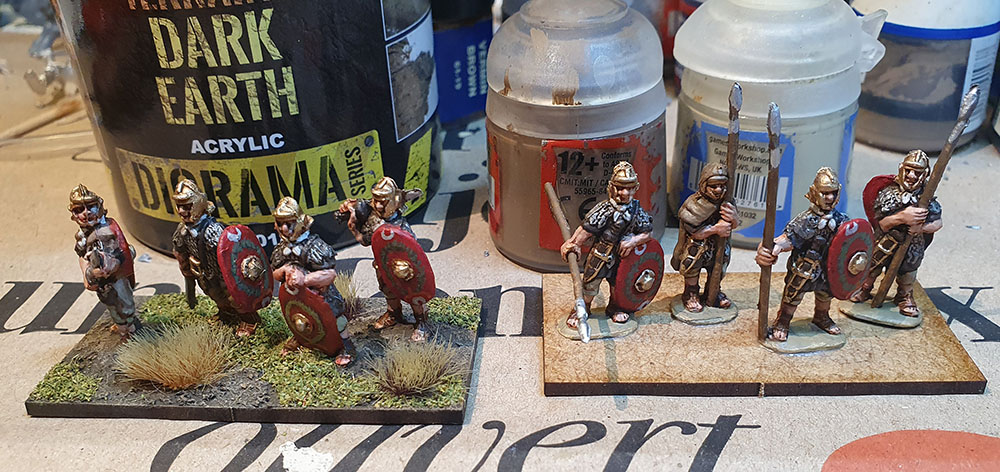
Let's begin with the Auxilia: 2 more elements for ADLG. All shields are hand painted, and I must say that I am quite happy with the green ones.

Hät figures

Strelets figures

All Auxilia together:


Then we have a look at the 4 missing legionaries:

Strelets figures

My 3 ADLG Legionaries elements are now complete:


Time to take some family pictures:


The 100 points ADLG army is not yet complete: I need to paint the generals (with their officers or guards, 6 figures) and... the camp :(  

After that, the next step is to upgrade to a 200 points army for which I need 116 figures, only 54 to paint!

Hope you like them :)  


mardi 18 juillet 2023

DBA Early Imperial Roman Army complete and based

 Sometimes, one of my never ending projects comes to an end. Today, ladies and gentlemen, I have the pleasure to announce you that my 12 elements Early Imperial Roman (EIR) army for DBA is complete. All necessary figures are painted, and more, what can be seen as a milestone event is that all figures are based, YES, ladies and gentlemen, and I prove it right now:


Aren't they nice when they are properly arrayed on the battlefield ? You can see that there are 12 elements - heavy infantry of course, with auxiliaries, cavalry and even some artillery.

Let's have a look et each unit.

First of them, the prestigious legionaries. These 3 elements are all part of  Legio XXI Rapax. All figures by Strelets, except for the centurio, slightly converted ESCI figure.

The next two elements are from a legion that I can't identify. Note that the pattern on the shields is different between both - it was engraved on the shields of the back element, which gives you no choice, but I love these old dear ESCI figures, and wanted to incorporate some in my army.

Now we have a look at auxiliaries. My documentation (WRG) says that the pattern on the shields is that of a foot auxiliary unit, but I don't know which one. Strelets figures.

Next we have the auxiliary archers. The would be best employed on eastern fronts (where they come from), but I like this figures, a mix of Hät and Airfix.

Now we go on with the cavalry units. First, we have a look at Numidian warriors, running through the flowers. Figures by Zvezda.

You can see next Roman Horse Auxiliary, maybe of Celtic origin, riding to fight against their Germanic enemies.

And last, a roman Scorpio. The DBA list allows to have one, which is fun, but I suppose that it was mostly used during sieges than on an open battlefield.

And a last family picture to conclude.

You may wonder why it took me so long to base these figures (some of them were painted for years).

Several reasons:

- I needed to wait until every figure was painted, so that I can make the same sort of bases for all

- I needed something better than my old cardboard that proved fragile in time - the MDF bases are really great, I recommend them

- I thought it would be very boring... and I was wrong. To say the truth, I really enjoyed it, and the flowers are a must :). And I think that the Germanic tribes will soon be based too.

Hope you like them, as always.

lundi 9 janvier 2023

EIR: first element based as a test shot

 Hi!

A small update today to show the first Early Imperial Roman element based as a test shot before basing the rest of the army.


 The next auxiliaries are eager to get a proper base

I first wanted to give them a Mediterrean or Middle East environment, since it is what I did for my first Ancient armies: Republican Romans, Carthaginians, Gauls, Achaemenid Persians... are all fighting all around the Sea. And I first wanted all my armies to have similar bases.

But, as one of the Lead Adventure Forum contributors recalled me, the Imperial armies are best known for the Dacian and Germanic campaigns, in more Central European landscapes than the previous armies, so I began to wonder if my wish of uniformity was the best idea to follow... and I eventually chose to use a darker color for the earth, and here you are.

In case you are interested, this is the recipe:

- paint a layer of AK Dark Earth terrain on the MDF base

- drybrush with light brown colors (GW Steel Legion Drab and Ushabti Bone)

- some grass from various manufacturers

Very simple, a bit different from the previous armies, but not too much.


I am interested to know if the test shot base looks credible to your eyes, any suggestion welcome.

 See you soon for the whole army based :)

dimanche 1 janvier 2023

Early Imperial Roman Army: Work in Progress

 First of all, I wish you a happy new year!

For the first day of 2023, let me show you my Early Imperial Roman (or EIR) army, based for DBA, then L'Art de la Guerre in the near future (my son just offered the V4 of the rules for Christmas, I must ready to play soon).

As the old readers of this blog know, I'm not fond of basing figures. I used to cut my own bases in cardboard boxes, which revealed two problems:

- the cut was irregular, the result was not always very nice with almost trapezoidal bases :D

- the bases used to twist with time, I had to rebase some old units

 So I was looking for a better way, and after a brief search on the web, I discovered that several companies were proposing some MDF bases (and movement trays as well). Sarissa Precision has a very wide range of bases, I could find what I needed for 1/72 or 20mm figures: 60x20mm for heavy infantry, 60x30mm for medium and light infantry, 60x40mm for cavalry, etc...

I bought a lot of them (for I have several armies to base), and as soon as I received the package, I used the newly painted Imperial Romans as a test, and here you are the result:


Some of you may recognize some of the figures that have been already displayed in older posts (the auxiliary archers, the ESCI legionaries, one or two legionaries and auxilia from the 2020 advent calendar), but most figures have been painted these last months.

You might also object that I didn't follow the DBA list to the letter. That is true, but all elements exist in the DBM list, so  let's say that it is a regional interpretation ;-)

All shields are hand painted (they're not as good as transfers, but I like my method).

Hope you like them :)

Better pictures to come when the bases are complete - the Reflex gives a better result, but you know that already.


mardi 22 décembre 2020

2020 Advent Calendar: Day 22

One more day in the calendar, and a Roman day again.

Day 22: Roman Legionaries in action

These Legionaries were made by Strelets. They're considered in action since they've already thrown their pila and drawn their gladii (swords), which tells us that the close combat will begin very soon.


They're meant to be part of my Early Imperial Roman army, together with the auxiliary archers (already shown here), and the other Romans of this calendar.


Very classical but a must-have for any Ancients wargamer.

See you tomorrow.

mercredi 16 décembre 2020

2020 Advent Calendar: Day 16

One step hotter... Imagine, for a moment, that you are surrounded by thousands of people speaking, screaming or shouting. Your feet are in the sand, a bright sun shines above you, really hot at noon. You have a strange sort of helmet on your head - you don't hear very well and you can't see everything. And moreover, another guy like you starts to strike heavily on your shield. A real nightmare...

For day 16, let's get a closer look at gladiators!


The man below is a Secutor (meaning 'follower' or 'chaser'). His equipment consists of a large shield, a gladius, and a characteristic helmet with two eye-holes. It is believed that this helmet was designed to make the Secutor the usual opponent of a Retiarius, armed with a trident: its shape would prevent the man from behing thrust in the face, and made him not easy do catch.

Emperor Commodus (2nd century AD) is known to have fought as a Secutor in the Coliseum in Rome.


This man is a Myrmillo. He wears a helmet with a huge dorsal fin, a large rectangular shield and a gladius. This crest is an evocation of the momylos, a sort of sea fish that gave his name to this sort of gladiator.


 That's all for today, see you tomorrow for the next day of the calendar :)


dimanche 13 décembre 2020

2020 Advent Calendar: Day 13

Between the foundation of Rome in 753 BC and the end of the Western Empire in the middle of the 5th century AD, the Roman civilization lasted more than thousand years. No wonder that this history keeps on fascinating so many people.

There will be no exception with this blog as we (re)discover today the most famous soldier of the Empire period.

Day 13 of the Advent Calendar: a Roman legionary in full armor, the Lorica Segmentata.

This soldier is the symbol of the Empire at its full extent. His duty is to protect the Roman world against the assaults of the Barbarians living beyond the edge of the known world. We can see him on guard duty in front of the door of a wooden fort. I like this standing pose, popularized by Strelets in the past years. And this big shield was a real temptation for a painter :)


Our legionary is soon disturbed by two of his comrades coming back from reconnaissance - yes, the very same that were on display on Day 7 of the Calendar. What sort of discussion do they have ? I let you imagine.


The wooden palissade with a door comes from the Zvezda range. It was originally designed to be part of a wooden Russian fort in the 14th century AD.

See you tomorrow !


lundi 7 décembre 2020

2020 Advent Calendar: Day 7

Back to Ancients, in a time when the density of population allowed you to stand without seeing anyone else... except for your comrade on duty with you.

For day 7 of the calendar, let's go to the edge of the Roman Empire.

As the Empire kept on growing, more and more soldiers were needed in the army. There were never enough legionaries to control the borders, so non citizen men were recruited in Auxilia units in order to assist the legionaries in battle. At the end of the service, these men could become Roman citizens.

The figures represent Auxilia during the early period of the Empire (1st and 2nd century AD). They wear mail armors and oval shields as defensive weapons. They also use spears and swords as offensive weapons.


Hope you like these simple, anonymous soldiers in Roman service.See you soon.


jeudi 11 octobre 2018

Early Imperial Romans: Auxiliary Archers

My brother and I have painted an Early Imperial Roman army some years ago, in a time when washing only had to do with the dishes in camping - only flat colours, without any lightening. But we were very proud of that army, in which we mixed Esci legionaries with Airfix Romans as auxiliaries.
One of its weaknesses was the lack of archers, since we only had one pose of archer in the Airfix set.

Years later, Hät released a set of Auxiliaries troops for Imperial Romans, and I bought it  because I was first interested in getting more poses for my Germanic warband. I was a bit disappointed with the archers that were too different from the Airfix - I thought it would be in contradiction with the uniformity I imagined for the most powerful army of antiquity.

Some more years passed, a few books about the Roman Empire had been read, I began to realize that uniformity, as we can imagine it today, was not a practice in antiquity - soldiers of the same corps were similar but only to a certain extent. And last week, as I was painting Germans, I suddenly remembered that I never used the Hät archers, and that they would probably look great together with the Airfix ones. I only had to find a good (and if possible, original and accurate) color scheme to paint them. Don't ask why, an off white tunic immediately seemed to be a good idea.

This is my unit of auxiliary archers for DBA, two 4xBw elements.


I guess you easily recognize the Airfix minis in the following pictures (the second from the left). They look good together with the Hät, don't you think ?


And last, this is a picture comparing two newly Airfix painted archers with the equivalent in the old standard. I would say it was worth repainting them.


Hope you're not fed up with the off white tunics :)